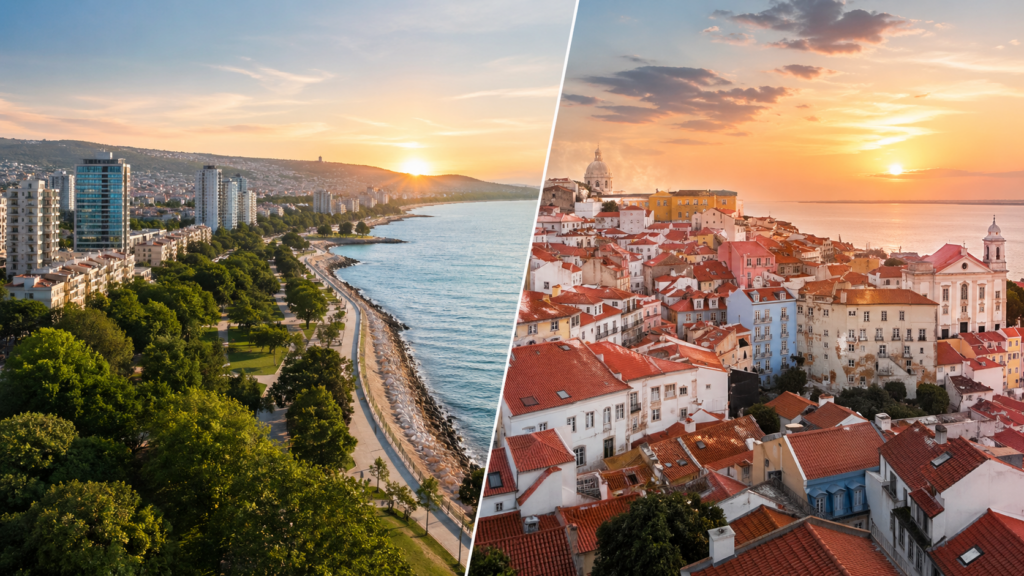
If you’ve started researching European retirement destinations, you’ve almost certainly landed on Portugal. It’s everywhere — travel magazines, expat forums, YouTube channels, financial independence blogs. Portugal has been the darling of the American retiree market for nearly a decade.
But there’s a problem: Portugal has become more expensive, more crowded, and more complicated for Americans navigating residency, housing, and taxes.
Bulgaria, on the other hand, is still flying under the radar — and that is precisely why the Americans who discover it often feel like they have found one of Europe’s last real retirement value plays.
This guide gives a direct, honest comparison of both countries across the factors that matter most to U.S. retirees: cost of living, real estate, residency, taxes, healthcare, and lifestyle. No fluff, no hype — just a practical 2026 comparison.
First: Why Portugal Became So Popular — And What Changed
Portugal earned its reputation for good reasons. It offers a warm Atlantic climate, beautiful coastal cities, EU membership, a large English-speaking expat community, and a cost of living that once felt dramatically cheaper than the United States.
The Non-Habitual Resident (NHR) tax program also made Portugal extremely attractive to foreign retirees and investors for many years. Lisbon, Porto, the Algarve, Madeira, and Cascais became regular names on “best places to retire abroad” lists.
The challenge is that popularity has consequences. Housing costs have risen sharply, prime expat areas have become more crowded, the original NHR program has been scaled back, and visa processing has become more competitive and slower in many cases.
Portugal is still a beautiful and highly livable country. But for Americans looking for the affordability that originally made Portugal famous, it is no longer the obvious bargain it once was.
That is where Bulgaria enters the picture.
Cost of Living: Bulgaria Wins — And It Is Not Close
This is where Bulgaria separates itself most clearly.
Monthly budget for a couple in Varna, Bulgaria: $1,500–$2,500
Monthly budget for a couple in Lisbon or the Algarve, Portugal: $2,500–$3,800
Monthly spending for many U.S. retirees: often far higher once housing, insurance, transportation, and medical costs are included.
Let’s break it down by category:
Housing
- Bulgaria: In Varna, a well-located 2-bedroom apartment often rents for $400–$900/month depending on location, quality, and season. Sea-view or central apartments cost more, but remain far below comparable Western European coastal cities.
- Portugal: In Lisbon, Porto, Cascais, and the Algarve, rents have increased significantly. A modest apartment in a desirable area can easily cost €1,000–€1,800/month or more, especially near the coast.
Food and Dining
- Bulgaria: A casual sit-down meal often runs $8–$15 per person, and groceries remain significantly cheaper than in most of Western Europe.
- Portugal: Dining is still more affordable than many parts of the U.S., but tourist and expat-heavy areas are noticeably more expensive than Bulgaria.
Healthcare
- Bulgaria: Private specialist visits commonly cost a fraction of U.S. prices, and dental care is especially affordable.
- Portugal: Healthcare is good and still affordable by U.S. standards, but private care and insurance are generally more expensive than in Bulgaria.
Transportation
Both countries offer good public transit in major cities. Neither requires a car in urban areas, although retirees who want rural or coastal flexibility may prefer having one.
Bottom line: Bulgaria can offer roughly 40–60% lower living costs than comparable expat living in Portugal, especially for retirees focused on housing, dining, healthcare, and everyday expenses.
Real Estate: Bulgaria Still Offers Better Entry Prices
Both countries have seen property appreciation, but they are starting from very different price levels.
- Bulgaria: Coastal apartments in Varna can still often be found in the $80,000–$200,000 range depending on location, condition, and sea proximity.
- Portugal: Similar properties in Lisbon, Cascais, the Algarve, or other high-demand areas can cost two to three times as much.
Bulgaria’s market has also been rising quickly. The country officially adopted the euro on January 1, 2026, which removed currency risk for eurozone buyers and increased investor attention. That means the window of extreme affordability is narrowing, especially in desirable coastal cities such as Varna and Burgas.
The opportunity in Bulgaria is not gone. But Americans who are thinking “I will wait another year or two” should understand that prices are moving. Buyers entering now may still find genuine value compared with Portugal, Spain, or Italy.
One structural advantage for Americans: U.S. citizens can own apartments and buildings in Bulgaria directly. Land ownership has additional rules and may require a company structure, but for the residential apartments most retirees consider, ownership is usually straightforward with proper legal guidance.
Residency: Two Different Paths
Both countries offer residency pathways for non-EU Americans, but the experience is different in practice.
Portugal
The primary route for many American retirees is the D7 Passive Income Visa. It is designed for applicants with stable passive income such as pensions, Social Security, rental income, investment income, or other qualifying resources.
Applicants generally apply through the Portuguese consulate process before relocating, then transition to a residence permit after arrival. After five years of legal residency, Portugal may offer a path to permanent residency or citizenship, subject to language and other requirements.
The Golden Visa, once a major draw for real estate investors, was significantly restructured in 2023. Direct real estate purchases and simple capital deposits no longer qualify. Remaining routes focus more on investment funds, cultural support, business creation, and job creation.
What to know: Portugal remains popular, and that popularity can mean backlogs, higher rents, more competition, and a more complex planning process.
Bulgaria
Bulgaria’s residency options for Americans may include pensioner residency, business representative status, property-linked residency above certain thresholds, or other legal pathways depending on your situation.
Bulgaria fully joined the Schengen Area on January 1, 2025, and adopted the euro on January 1, 2026. That gives Bulgaria a stronger European integration profile than it had just a few years ago.
The Bulgarian process can be more affordable and less saturated than Portugal’s, but it still requires correct documents, translations, local filings, and legal guidance. Americans should work with qualified professionals before making commitments.
For Americans who want clarity: This is exactly the type of guidance we provide in our free consultation — walking through which residency pathway makes the most sense for your timeline, income, and goals before you make any commitments.
Taxes: Bulgaria Has a Clear Edge for Many Retirees
Tax treatment of foreign retirees is one of the most important — and most overlooked — factors in a European retirement decision.
Bulgaria
Bulgaria has a flat 10% personal income tax rate, one of the lowest and simplest systems in the European Union. There is no general wealth tax, and the country has a tax treaty with the United States to help prevent double taxation.
Foreign pension income and U.S. Social Security treatment should always be reviewed with a qualified cross-border CPA, but Bulgaria is generally considered much simpler and more tax-friendly than many Western European destinations.
Portugal
Portugal taxes residents on worldwide income and uses progressive tax rates that can reach up to 48%, with additional solidarity surtaxes at higher income levels. The original NHR program that made Portugal famous among tax-conscious expats has been substantially changed, and the newer regime is more limited.
U.S. citizens remain required to file U.S. tax returns on worldwide income regardless of where they live. A U.S.-Portugal tax treaty helps reduce double taxation, but the interaction between Portuguese taxes and U.S. obligations requires careful planning.
Bottom line: For American retirees living on Social Security, pensions, IRA distributions, and investment income, Bulgaria’s flat 10% structure is often easier to understand and may be more favorable than Portugal’s progressive system.
Healthcare: Both Are Solid. Bulgaria Is More Affordable.
Neither country should be compared to the United States only by hospital size or medical technology. The better question for retirees is practical: can you access good routine care, specialists, prescriptions, dental care, and private treatment without the financial stress common in the U.S.?
Bulgaria:
Private hospitals and clinics in Varna, Sofia, and other larger cities are modern, accessible, and affordable. Specialist visits, dental care, imaging, and routine private care are typically far less expensive than in the United States.
Portugal:
Portugal has a respected public healthcare system available to eligible legal residents, along with a strong private healthcare sector. Costs are much lower than in the United States, though generally higher than in Bulgaria.
Important note: U.S. Medicare does not cover either country. American retirees should budget for private international or local health insurance, at least during the transition period.
Lifestyle: Different Flavors of European Retirement
This is where preference matters more than math.
Portugal
Portugal delivers classic Western European charm — old-world architecture, Atlantic coastline, wine, seafood, café culture, fado music, and a large established expat community. English is widely spoken in Lisbon, Porto, Cascais, and the Algarve, making the transition easier for many Americans.
The Algarve has long attracted British, Irish, and American retirees. Cascais attracts wealthier internationals. Madeira and the Azores offer quieter alternatives for those who want island life.
Bulgaria
Bulgaria offers something different — and if it resonates with you, it tends to really resonate. Varna on the Black Sea is a walkable coastal city with beaches, parks, restaurants, shopping, medical care, and a slower pace of life. Sofia offers more urban energy, culture, and international connections.
Bulgaria’s culture is Eastern Orthodox with Slavic roots, so it feels distinctly different from Western Europe. Some retirees find that refreshing. English is spoken in expat circles, hospitality, tourism, and among younger Bulgarians, though not as universally as in Portugal.
One thing many Americans notice is that Bulgaria still feels less saturated by expat pressure than Portugal. That can make the experience feel more authentic, more affordable, and less crowded.
Head-to-Head Summary
| Factor | Bulgaria | Portugal |
|---|---|---|
| Monthly budget for a couple | $1,500–$2,500 | $2,500–$3,800 |
| Real estate entry cost | Lower | Higher |
| Income tax structure | Flat 10% | Progressive, up to 48% |
| EU membership | Yes | Yes |
| Schengen access | Yes | Yes |
| Currency | Euro | Euro |
| English widely spoken | Moderate | High |
| American expat community | Growing | Large and established |
| Healthcare | Affordable private care | Public + private system |
| Best fit | Value-focused retirees | Established Western Europe lifestyle |
So Which Is Right for You?
Portugal may be the better choice if:
- You want an immediately familiar Western European environment
- You prioritize a large, established English-speaking expat community
- You prefer Atlantic coastline and a milder ocean climate
- Your budget allows for higher housing costs
- You value Portugal’s name recognition and established retiree infrastructure
Bulgaria may be the better choice if:
- Maximizing your purchasing power is a priority
- You want Black Sea living at a significantly lower entry cost
- You are drawn to an emerging destination before it becomes mainstream
- A flat 10% tax structure is appealing for your income profile
- You want to buy real estate while meaningful value still exists
The honest answer: many Americans who visit Varna come back surprised. They expected a lesser-known alternative to Portugal and found a genuinely compelling European coastal city — often at roughly half the cost.
Your Next Step
If Bulgaria has caught your attention — even just as a comparison — the most useful thing you can do is have a real conversation with someone who understands both sides of the decision: the U.S. financial picture and the Bulgarian reality.
That is what we offer at RetireInBulgariaUSA.com. Our advisors are U.S.-based, English-speaking, and backed by 32+ years of U.S. real estate and mortgage experience. We will walk you through the honest picture on costs, residency, and property — and when you are ready, introduce you directly to our licensed local partner in Varna.
No pressure. No obligation. Four minutes to fill out the form.
Start Your Free Consultation →
RetireInBulgariaUSA.com is operated by Axel Real Estate & Home Loans Inc., a U.S.-based advisory company. We are not licensed real estate brokers in Bulgaria. Property transactions are handled exclusively by licensed local partners. This content is for informational purposes only and does not constitute tax, legal, immigration, or financial advice. Please consult qualified professionals before making relocation, tax, legal, or property decisions.
Leave a Comment