If you’ve been dreaming of a European retirement, Spain and Italy have probably topped your list. They are beautiful countries with rich culture, great food, historic cities, and warm climates. Nobody is going to argue with that.
But here is what the travel magazines do not always tell you: for a growing number of American retirees, Spain and Italy have become more expensive, more crowded, and more bureaucratically exhausting than they expected. A quieter alternative on the Black Sea coast is starting to look very attractive by comparison.
Bulgaria is not on most Americans’ radar yet. That is exactly why the Americans who find it often feel like they have discovered something real before the mainstream arrives.
Here are 10 concrete reasons why Americans are increasingly looking at Bulgaria — and especially Varna on the Black Sea — instead of only focusing on Spain or Italy.
1. Your Money Goes Roughly Twice as Far
Let’s start with the number that matters most.
A comfortable retirement lifestyle for a couple in Varna, Bulgaria can often run approximately $1,500–$2,500 per month. That can include a well-located apartment, regular dining out, private healthcare access, transportation, and leisure.
In Spain, a modest comfortable lifestyle for a couple may be possible in smaller cities for less, but popular areas such as Madrid, Barcelona, Valencia, Málaga, and the Costa del Sol can easily push costs much higher. In Italy, costs vary widely by region, but Rome, Florence, Milan, coastal towns, and major tourist areas are typically far more expensive than Bulgaria.
Bulgaria cuts retirement costs dramatically. Spain and Italy can still be cheaper than many parts of the United States, but Bulgaria usually stretches a fixed retirement income much further.
2. Bulgaria Has One of the Lowest Flat Taxes in the EU
This one surprises most Americans. Bulgaria has a flat 10% personal income tax rate, one of the lowest and simplest tax systems in the European Union.
Compare that to:
- Italy: National income tax rates generally run from 23% to 43%, plus regional and municipal taxes.
- Spain: Progressive tax rates vary by region and can reach high levels for tax residents, with additional complexity around pensions, investments, and foreign assets.
For American retirees living on Social Security, pension income, IRA withdrawals, and investment income, Bulgaria’s 10% flat structure is easier to understand than the layered systems in Spain or Italy. A U.S.–Bulgaria tax treaty is also in place to help prevent double taxation.
Important note: U.S. citizens still file U.S. tax returns on worldwide income. Before moving, consult a qualified U.S. expat CPA who understands both U.S. and Bulgarian tax rules.
3. Real Estate Is Still Genuinely Affordable
Spain and Italy have both seen significant property appreciation in recent years, especially in desirable coastal cities, historic centers, and major expat destinations.
Bulgaria remains at a much lower entry point. In Varna, sea-view or well-located apartments can still often be found in the $80,000–$200,000 range depending on size, condition, building quality, and proximity to the water.
That gap represents real purchasing power. A property that costs $120,000 in Varna might cost two or three times that amount in a comparable Spanish coastal city, and potentially more in Italy’s tourist-heavy areas.
One important note: Bulgaria adopted the euro on January 1, 2026, which has increased investor attention and made the market easier for eurozone buyers to understand. Property values have already been rising, and the window of truly exceptional affordability is narrowing — but it has not closed yet.
Americans buying in Varna today may still be getting in before Bulgaria becomes a mainstream retirement destination.
4. The Visa Process Can Be More Accessible
To retire in Spain, many Americans use the Non-Lucrative Visa, which requires proof of sufficient passive income or savings. The standard benchmark is tied to 400% of Spain’s IPREM for the main applicant, plus additional funds for dependents.
Italy’s Elective Residency Visa also requires applicants to prove stable passive income and sufficient resources, and the process can be paperwork-heavy depending on the consulate.
Bulgaria’s pensioner residency pathway can be more accessible for Americans receiving Social Security or pension income. The process typically begins with a Type D long-stay visa, followed by a residence permit application after arrival in Bulgaria.
The Bulgarian process still requires proper documentation, translations, health insurance, proof of accommodation, and legal guidance. It is not effortless. But for many retirees, the financial threshold and overall process can feel more realistic than Spain or Italy.
5. Full EU, Schengen, and Eurozone Access
Bulgaria joined the European Union in 2007, became a full Schengen Area member on January 1, 2025, and adopted the euro on January 1, 2026.
This matters for American retirees because it means:
- EU legal and property frameworks
- Schengen travel access across most of Europe
- Euro currency stability without lev-to-euro exchange complexity
- NATO membership since 2004, which matters for long-term political stability
Spain and Italy offer these same European advantages. Bulgaria’s advantage is that it offers them at a much lower cost of living.
6. Private Healthcare Is Good and Inexpensive
Spain and Italy both have strong healthcare systems. However, access rules, public-system registration, wait times, private insurance, and language barriers can vary depending on location and residency status.
In Bulgaria, private healthcare in Varna and Sofia is modern, accessible, and significantly more affordable than in the United States. Private specialist visits often cost a fraction of U.S. prices, and dental care can be dramatically cheaper than in America.
Private hospitals and clinics in Varna commonly serve international patients, and many expats use the private system for routine care, diagnostics, specialists, and dental work.
Remember: Medicare does not cover Bulgaria, Spain, or Italy. Expat health insurance should be factored into your budget wherever you choose to retire in Europe.
7. No Language Requirement for Residency — and English Is Workable
Italy can be challenging for Americans who do not speak Italian, especially outside major tourist centers. Spain is easier in expat-heavy areas, but Spanish remains important for government offices, healthcare, banking, and daily life.
Bulgaria’s official language is Bulgarian, written in Cyrillic, which looks unfamiliar to most Americans at first. But in Varna, English is commonly used in real estate offices, private medical settings, hospitality, tourism, and parts of the international community.
There is no Bulgarian language requirement for the standard pensioner residency pathway. Most expats can manage daily life in English in Varna while gradually learning basic Bulgarian.
Learning the local language is always respectful and helpful. But the practical barrier to starting life in Varna is often lower than many Americans expect.
8. A Black Sea Coastline That Still Feels Livable
Spain’s Costa del Sol, Costa Blanca, and Balearic areas are beloved — but also crowded, especially in summer. Italy’s Amalfi Coast, Cinque Terre, Lake Como, and other iconic destinations are beautiful but often expensive and heavily touristed.
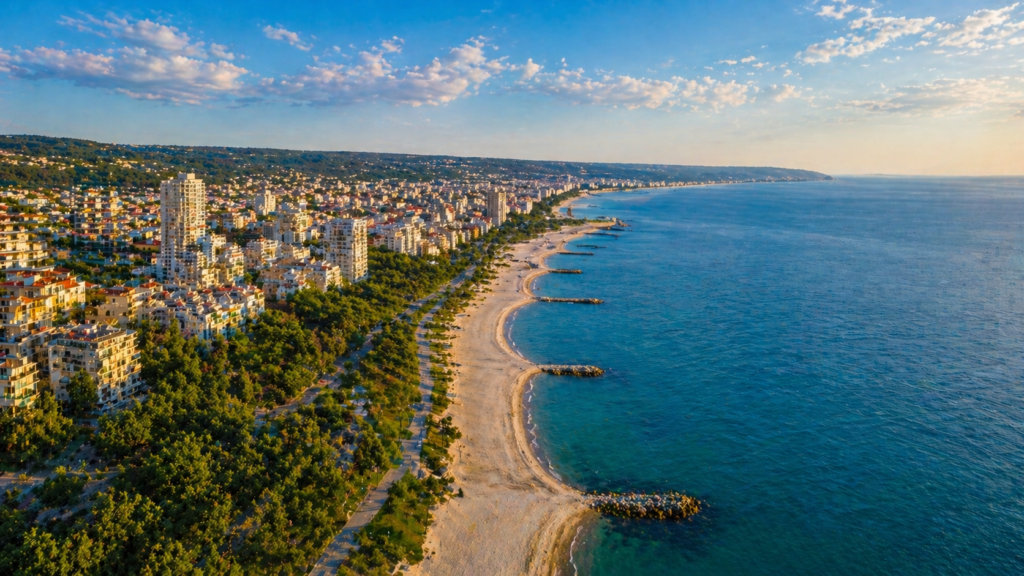
Varna’s Black Sea coastline offers beaches, a walkable promenade, parks, restaurants, shopping, medical care, and a genuine seaside lifestyle without the same level of tourist density found in many Western Mediterranean hotspots.
The city also has an international airport with connections to major European hubs. The pace is relaxed, the waterfront is accessible, and the city still feels like a place where people live — not just a destination built around visitors.
For Americans who want European coastal living without the pressure and prices of Spain or Italy’s most famous areas, Varna offers something increasingly rare.
9. You Are Early — Not Too Late, But Early
Portugal was an outstanding retirement value years ago. Then it became famous, prices rose, visa rules changed, and housing pressure increased. Spain’s most popular expat areas are moving in a similar direction, with rising rents, strong demand, and growing local concern over housing affordability.
Bulgaria in 2026 still feels earlier in the cycle. Infrastructure is improving, the expat community is growing, the euro has arrived, and the country is now fully inside Schengen. Yet prices remain far below most comparable European coastal markets.
The Americans moving to Varna now are arriving before Bulgaria becomes a mainstream retirement headline. That may matter for both lifestyle and real estate value.
10. Americans Who Visit Varna Often Come Back Surprised
This is one of the most consistent reactions we hear.
Many Americans arrive expecting a compromise — a lesser version of Western Europe. Instead, they find a modern, walkable coastal city with beaches, restaurants, parks, shopping, private healthcare, friendly locals, and a quality of life that feels better than expected.
Spain and Italy are genuinely wonderful. No one is telling you to dismiss them. But wonderful places come with price tags, and those price tags have increased significantly over the last decade.
Bulgaria, and Varna specifically, offers a different answer to the same question: How do I actually afford to live well in Europe?
The Honest Caveat
Bulgaria is not for everyone. If you need a very large, established American expat community, Varna is growing — but it is not yet the size of the Algarve, Costa Blanca, or major Italian expat regions.
If you are deeply drawn to Italy’s food culture or Spain’s language and Mediterranean lifestyle, those are real factors worth respecting. Retirement is not only math. It is also emotion, lifestyle, comfort, and fit.
But if you are looking for a comfortable, secure European retirement at a price that actually works on a real American retirement income, Bulgaria deserves a serious look.
Ready to Find Out If Bulgaria Is Right for You?
The best next step is not more random research. It is a real conversation.
Our U.S.-based advisors have 32+ years of real estate and mortgage experience. We will walk you through the honest picture on costs, residency, property, and what life in Varna actually looks like for Americans — and when you are ready, introduce you directly to our licensed local partner in Varna.
No pressure. No obligation. Four minutes.
Start Your Free Consultation →
RetireInBulgariaUSA.com is operated by Axel Real Estate & Home Loans Inc., a U.S.-based advisory company. We are not licensed real estate brokers in Bulgaria. Property transactions are handled exclusively by licensed local partners. This content is for informational purposes only and does not constitute tax, legal, immigration, property, or financial advice. Please consult qualified professionals before making relocation, tax, legal, or property decisions.
Leave a Comment